


The person who grows most through training is the trainer
Who grows the most through a training program?
Probably the trainer.
Why?
First, in the preparation stage, trainers spend many times the length of the training itself.
In our case, that preparation includes researching the latest credible studies, profiling the participants, and customizing the materials and program design based on that.
Trainers then practice so they can deliver what they have prepared in their own words, and only then does the day itself arrive.
In this process of reorganizing what they have taken in and putting it out again, the knowledge and skills become part of them.

Input and output: the two wheels of learning
Let's think about language learning.
For example, many of you have probably learned new English words or phrases, only to forget them quickly because you had no chance to use them.
To prevent this as much as possible, training companies like ours make sure there are opportunities for discussion (chances to produce output) during training.
Unfortunately, that alone is not enough.
If someone asked whether you could master English with just a few English conversation lessons a year, most of you would probably say it is not that easy.
In the same way, it is hard to say that attending a few training programs a year is enough to build solid business skills.
At the same time, attending training every day is not realistic either.
That is why, to maximize the effect of the valuable training you occasionally attend (to make sure the knowledge and skills you learned truly become your own), creating opportunities for output after the training becomes dramatically important.
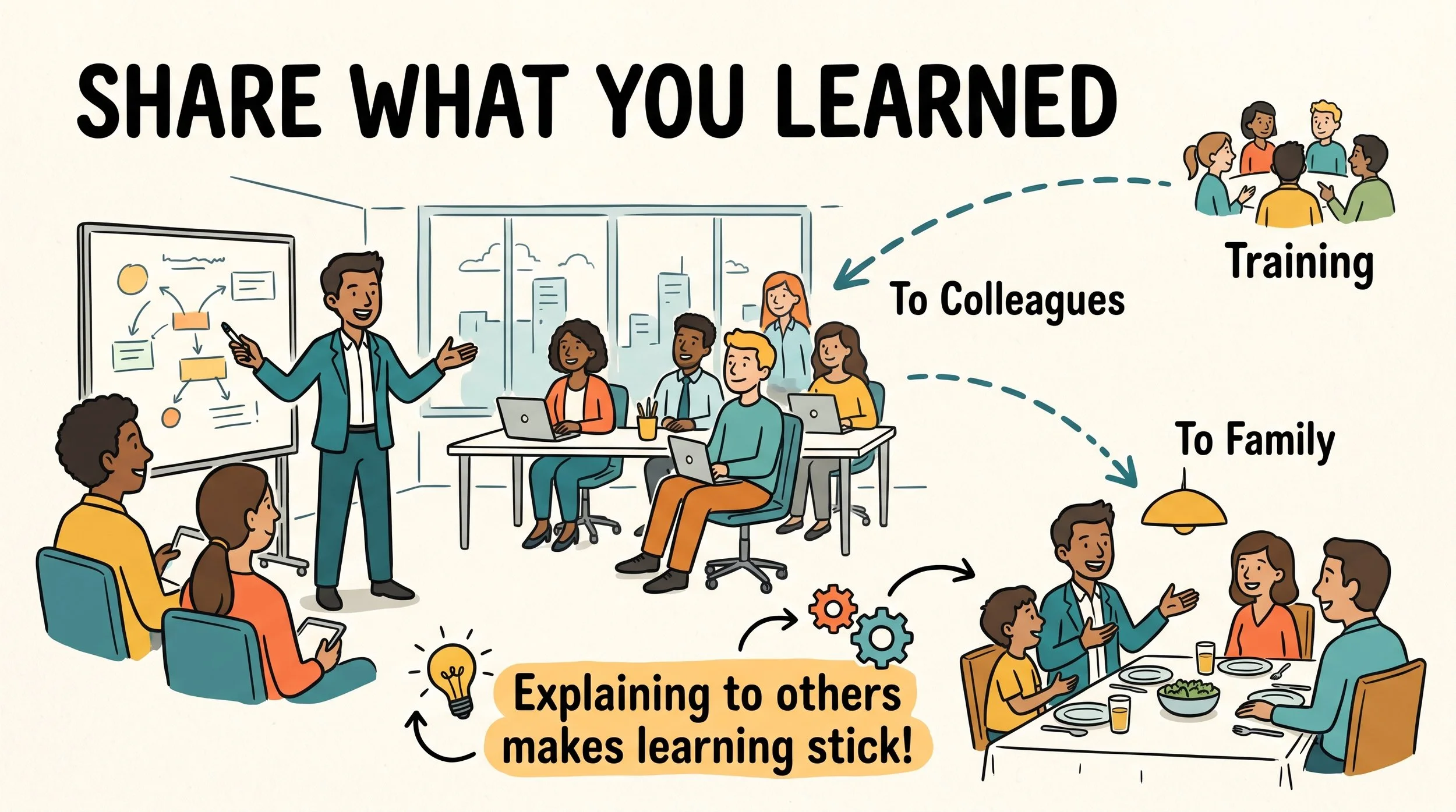
Share what you learned
So what, concretely, should you do?
In many cases, HR or the trainer will tell you, "Please put this into practice on the job."
On top of that, I recommend not only using what you learned yourself, but also sharing it with your family when you get home, or with your team members or family the next day.
Why?
To explain something to someone else, you need to reconstruct your own understanding, and in the process, it becomes clear which parts you understand and which you do not.
Parts that might stay vague if you only reflect or practice on your own cannot be ignored once you have to explain them to someone else.
In this way, the cycle of teaching what you have been taught is effective for making learning stick.
A culture of teaching and being taught

There is a company that practices this systematically: Toyota Motor Corporation.
At Toyota, in-house trainers called "advisors" are developed to coach participants (their juniors) (https://pls.precena.co.jp/customer/toyota-motor/).
In other words, Toyota has a "system" in which people pass on what they learned in training and on the job to their juniors as advisors, and it has been running for many years.
I believe this "culture of teaching and being taught" is one of Toyota's strengths.
If you are struggling to make skills stick after training, rather than ending your follow-up with a training report, consider building in a step where participants teach what they learned to someone else. It may make a difference.
Reference
・Case study: Toyota Motor Corporation (Precena Strategic Partners, in Japanese) (https://pls.precena.co.jp/customer/toyota-motor/)