

Can a One-Day Training Program Change People?

My answer is "no."
Training is one of the pillars of my business, yet when asked whether training "alone" can change people, I make a point of answering "no."
After a training session, it is not unusual to receive comments such as
“This was the best training I have ever attended”
“It changed the way I think”
“It broadened my perspective.”
But a full-day (8-hour) training program held once a year, for example, accounts for only 0.4% of annual working hours*.
*Based on 8 hours/day × 20 days/month × 12 months.
However highly a training program is rated, I believe it is arrogant to conclude from that alone that a person has changed, or will change.
Then is training completely unnecessary?
My answer to that is also "no."
Otherwise, I would never have thought of devoting my life to people development.
Let me explain why in a little more detail below.
90% of a leader's learning happens on the job
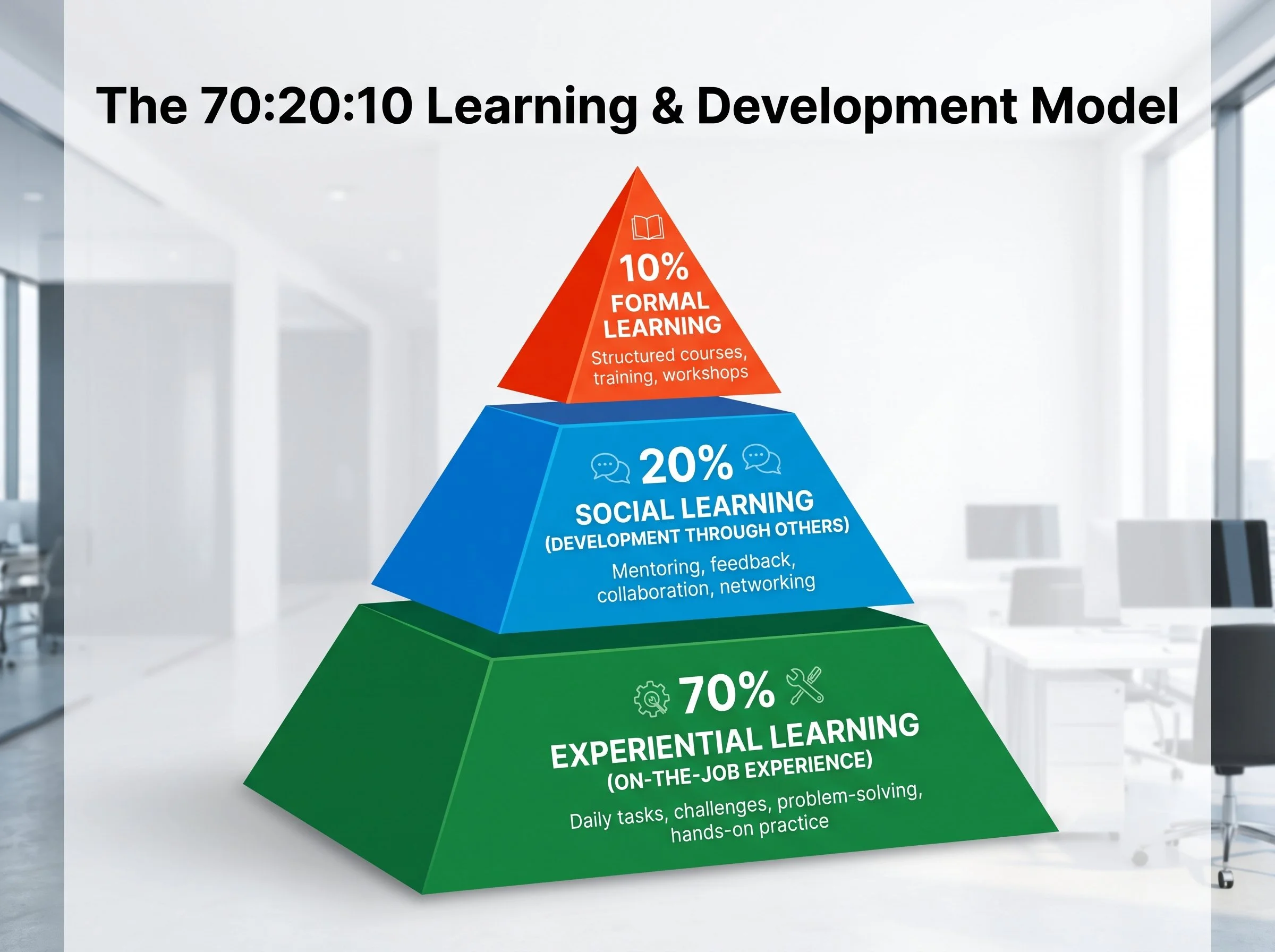
In the HR world, there is a well-known study behind the "70:20:10 rule."
It finds that leaders who perform well at the front line gain 70% of their learning from their own experience, 20% from feedback from the people around them, starting with their managers, and 10% from reflection through training, books, and the like.
In other words, what matters most in people development is strategic placement and task assignment, and strengthening managers' ability to guide their people.
This is why we, in our own modest way, focus on building the skills of Japanese leaders working overseas and of local evaluators and next-generation leaders, and on supporting the design of HR systems and evaluation processes.
So, is training for a broad range of employees (the 10% of reflection) completely meaningless?
Of course not.
The 10% of reflection changes the quality and speed of the 90% learned on the job
Most people look at a recipe when they cook a dish for the first time.
You could cook by intuition and experience, but it goes without saying that following a recipe, in which experts have already worked out scientifically how to make the dish taste good, gets you to a delicious result more efficiently.
Business is the same.
The frameworks taught in many training programs distill, from a large number of cases, the secrets to delivering results consistently and with a high probability of success.

Yoshiharu Hoshino, CEO of Hoshino Resorts
In a Nikkei Business feature ("Hoshino Resorts CEO: Management that goes '100% by the textbook' makes a company stronger"), Yoshiharu Hoshino, CEO of Hoshino Resorts, made the following comment:
"What I use are textbooks written by researchers, and all of them derive principles from an accumulation of corporate cases. Their content belongs to the world of science, just like medicine or chemistry, and has been proven correct. Through textbooks, I learn proven principles and apply them to management."
This is why I answer "no" to the question, "Is training completely unnecessary?"
There is a clear reason why, in the study above, 10% of learning is attributed to reflection through training and similar means.
The difference between "being able to do" and "being able to teach"
There is one more benefit to learning frameworks through training and books, and reflecting on your work against them.
That is "putting skills into words."
Whether or not you have this skill of articulation is the watershed that separates a great player from a great manager.
Let me explain a little more.
If asked, "Are there people who can deliver results at work without attending training?", I would answer, "There probably are."
In fact, many busy businesspeople likely have a negative impression of training: "Attending training is a hassle," "It's a waste of time," or "I don't need it."
But training is not only for "learning what you don't know" or "learning what you can't yet do." It can also be used to "put the skills you use unconsciously every day into words, using proven frameworks, so that your team members can easily reproduce them."
For this reason too, supporting the skills of leaders is an essential move to strengthen an organization.
Conclusion: Aim three arrows strategically
In short, the royal road to developing leaders seems to be to strategically* design three arrows:
Appropriate assignments (experience)
The design and operation of evaluation processes (feedback)
Consistent, regular training (reflection).
For what I mean by "strategically," please see this article (in Japanese).
Conversely, if you feel your organization lacks, or is weak in, any one of these arrows, it may be worth considering how to design that missing arrow.
References
・Nikkei Business, feature article: "Hoshino Resorts CEO: Management that goes '100% by the textbook' makes a company stronger" (in Japanese)