

The Smarter AI Gets, What Remains for Humans

A Question I Am Often Asked by Business Leaders
“How will talent development change in the age of AI?”
As a professional in talent management and organizational development, I frequently receive this question from the business leaders I partner with. The inquiry of "what future skills will be required of humans?" is likely a pressing concern not only for executives but for every business professional and parent.
There are two typical frameworks for answering this question.
One is the extreme view that "if we automate with AI, human workers will become obsolete." The other is the comforting narrative that "there are still many limitations to AI, so human jobs are secure."
The latter narrative provides reassurance to the audience. However, tracking the latest AI research reveals that this premise of "what AI cannot do" is collapsing much faster than anticipated.
Therefore, in this article, I would like to answer this question from a slightly different angle. Rather than asking "what are the limitations of AI?", I will approach it from the perspective of: "even as artificial intelligence evolves and expands its capabilities, what core responsibilities must humans continue to fulfill?"
Chapter 1:
Four Roles That Remain with Humans, Even as AI Becomes More Capable
Artificial intelligence excels at processing and analyzing massive datasets. Given the right parameters, it can successfully execute predictive analytics for the future. Furthermore, as we will explore in subsequent chapters, AI is already performing at a high level when it comes to generating innovative ideas and reading human emotions.
Even so, a careful review of academic research and business case studies clearly highlights specific domains that humans must continue to manage. I have categorized these into the following four essential roles:
The strategic will to bet on the future
AI can generate highly novel ideas. However, upon actual execution, the evaluation of these ideas tends to flip in favor of human-generated ones. It is human leaders who must decide which initiatives to invest in and drive them through to completion.
Primary data verified in the field
AI can only access and reference digitized information. It cannot reach the authentic, first-hand insights that a trusted individual verifies on the ground.
Trusted relationships built on authentic engagement
AI can formulate the emotionally "correct" response. However, whether those words truly resonate with another person depends on day-to-day interpersonal relationships and authentic personal involvement.
Accountability for outcomes
Even if an AI system provides incorrect guidance, the organization bears the ultimate responsibility. There are actual legal precedents confirming this accountability.
These four points share a common thread. None of them relate to AI capabilities. Rather, they address human roles and who assumes accountability within society. The capability gap will inevitably shrink with technological advancement. However, human roles will not easily be outsourced, regardless of how advanced the technology becomes.
Therefore, I believe the core question should be reframed as follows.
It is not about identifying what AI cannot do. Rather, it is about defining what humans must take responsibility for, even if AI can perform the task.
In the following chapters, we will examine these four roles sequentially. I will explore each by integrating empirical facts verified by scientific research with my own professional experience. (Note: The AI capabilities discussed here are based on state-of-the-art research as of 2026.)
Chapter 2:
Vision Is Not an Idea, but an Act of Will
AI's Capability to Generate Novelty
First, we must establish the fact that AI is already capable of generating novelty and innovation.
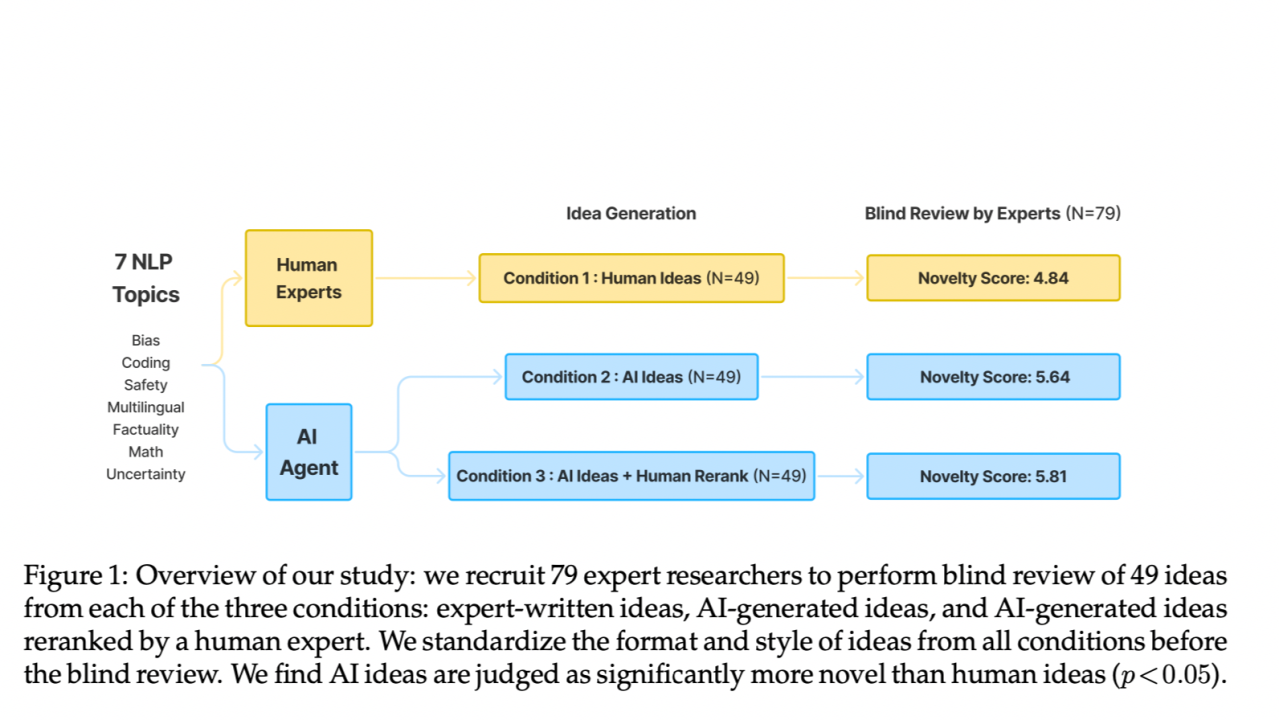
In 2024, a research team at Stanford University conducted an experiment involving over 100 natural language processing researchers. They tasked both the human researchers and an AI model with generating research ideas, which were then evaluated blindly by experts. The results demonstrated that the AI-generated ideas were rated as having a statistically significant higher novelty (although they were noted to be slightly inferior in feasibility).
On the specific metric of novelty, AI has already achieved a level equal to or surpassing that of human subject matter experts.
The Ideation-Execution Gap: Reversals After Implementation
What is particularly compelling is a follow-up study published by the same Stanford team in 2025. This time, they recruited 43 researchers to actually execute both the AI-generated ideas and the human-generated ideas as real-world research projects.
Consequently, in the post-execution evaluations, the AI's ideas experienced a significant drop in scores compared to the human ideas across all performance metrics, including novelty and effectiveness. In many of these metrics, the rankings completely flipped. The research team conceptualized this phenomenon as the ideation-execution gap.
Furthermore, there was another crucial finding in the initial study that cannot be overlooked. It was observed that the higher the volume of ideas the AI was prompted to generate, the more it tended to output repetitive and similar concepts.
"Plausible novelty" and "the will to bet"
I believe the insights derived from these two studies can be summarized as follows. AI can generate a massive volume of plausible novelty. However, the critical decisions of which ideas to bet on and the perseverance to execute them despite obstacles require human will and commitment. These are traits that an AI simply cannot produce.
A corporate vision, meaning the target future state an organization strives to create, is not merely an idea. It represents the strategic will to declare, "This is the organization we want to become," and the accountability to drive toward that goal.
What I see in Japanese companies on the ground
While supporting talent development initiatives for Japanese companies in the ASEAN region, I frequently observe a specific trend. Japanese organizations excel at forecasting a future that serves as a linear extension of the past. They possess exceptional capabilities for incremental improvement, bottom-up accumulation, and high-precision refinement. Conversely, I sense they are somewhat unaccustomed to envisioning a discontinuous future that breaks away from historical precedent.
While this is purely an anecdotal observation from my experience, I believe it highlights a potential strategic risk.
What happens if we delegate our strategic future planning to AI? It will likely output an average future that is highly plausible and logically sound, yet entirely devoid of genuine human will. If an organization lacks the practice of envisioning discontinuous futures, it may fall into the trap of feeling falsely reassured by the apparent validity of the AI's output.
It is highly beneficial to leverage AI for expanding the range of available strategic options.
However, making the ultimate executive decision to declare, "This is the path we take," remains strictly a human responsibility
Chapter 3 :
AI Cannot Create Information You Have Verified with Your Own Feet
The Bangkok floods and the information on social media
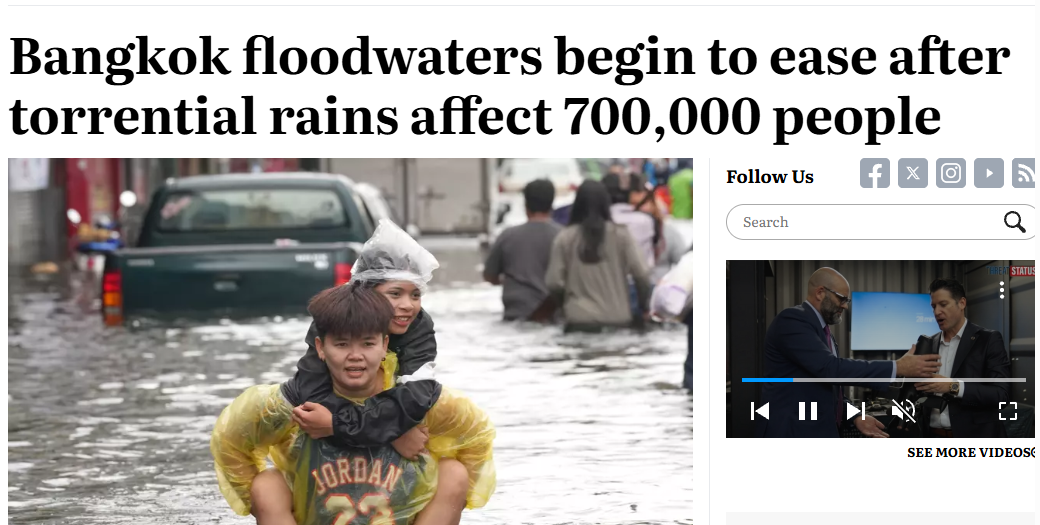
People wade through a flooded street after a heavy rain in Bangkok, Thailand, Monday, Sept. 28, 2026
In late September 2026, Bangkok was hit by large-scale flooding. On September 26, the Governor of Bangkok declared a state of emergency across all 50 districts of the city. News reports indicated this was potentially the worst flood in 15 years and affected approximately 700,000 people.
I had a business trip to Bangkok scheduled for the following week and was genuinely concerned. Social media feeds were saturated with videos of submerged roads and inundated homes. I needed to consider my own safety alongside the well-being of our training participants and consulting team.
As I gathered digital information, two primary questions emerged. Is this data genuinely current? Are older videos being recirculated to drive engagement? Furthermore, do these visuals even represent the specific districts I planned to visit?
A client went to see it with their own eyes
So I contacted a client on the ground directly and asked about the situation.
To my surprise, that client went out of their way to visit the area I was planning to go to, and confirmed with their own eyes that there were no problems there.
When I checked the news coverage later, the Associated Press had reported an interesting fact: although the state of emergency had been declared for all 50 districts, some districts had been relatively lightly affected. There was a large gap between the impression on social media that "all of Bangkok is underwater" and the actual situation in each area.
Ask AI, and you will get the same answer
What I want to consider here is what would have happened if I had asked AI at that time.
What AI refers to is digitized information, including social media and news sites. In other words, the same sea of information that had made me anxious. If that sea contains information whose freshness is unclear, or whose location is unclear, the same uncertainty will creep into AI's answers.
As long as there is information that has not been digitized, AI cannot be all-knowing.
What matters is that "a trusted person verified it with their own feet"
I should add one point, however. The undigitized world will keep shrinking. As sensors and cameras multiply, more and more of what happens on the ground will become data.
So I do not think the source of value is "being undigitized" in itself. What was truly valuable was that a trusted person went and verified it with their own feet.
The more information overflows, the more valuable firsthand information becomes when it is clear "who saw it, when, and where." Whether people will bring you such firsthand information depends on your day-to-day relationships. And if those relationships are not there, it is all the more important for leaders to go and check the site themselves.
This theme of "relationships" leads into the next chapter.
Chapter 4:
Knowing the "Right Answer" About Emotions Is Different from Being Trusted
AI is beginning to predict even human irrationality
Human beings are emotional creatures.
Both human decision-making and behavior are less rational than we often believe. Furthermore, artificial intelligence is now capable of capturing even this irrationality with remarkable precision.
In 2025, a study published in the journal Nature introduced an AI model named Centaur. This model was trained on 160 psychological experiments and over 10 million choice data points from more than 60,000 participants. The results demonstrated that Centaur could predict human behavior more accurately than existing cognitive science models. It also successfully adapted to novel scenarios outside its original training data.
The same rapid advancement applies to the domain of emotions. A research team from the University of Bern and the University of Geneva tasked six generative AI models with completing five distinct emotional intelligence (EQ) assessments commonly used in corporate environments. The AI models achieved an average accuracy rate of 81 percent. This significantly outperformed the human average of 56 percent.
Artificial intelligence can now understand both human irrationality and complex emotional dynamics with a high degree of accuracy.
Even so, people do not want to be persuaded by AI
Does this mean Emotional Intelligence is no longer a unique human advantage? I do not believe so.
What EQ assessments actually measure is theoretical emotional knowledge. They test whether a subject knows the appropriate feelings and behaviors for a given scenario. However, the true test in a professional workplace goes far beyond theoretical knowledge.
When a team member is feeling demoralized, knowing the correct words to say is completely different from delivering words that are genuinely accepted because of who is speaking them. The phrase "it will be okay" carries an entirely different meaning depending on the speaker. The weight of human words originates from day-to-day interpersonal relationships and the shared stakes of authentic personal involvement.
The EQ researchers themselves strongly emphasize that human supervision remains absolutely essential.
Knowing the scientifically correct emotional response is fundamentally different from being trusted as a deeply involved stakeholder. As AI becomes increasingly capable of handling the former, the intrinsic value of the latter will inevitably stand out even more.
AI may replace jobs, but it does not replace people
There is another foundational premise we must acknowledge. Artificial intelligence will likely replace certain human jobs. Temporary organizational restructuring will undoubtedly occur.
The Future of Jobs Report 2025 published by the World Economic Forum (WEF) projects significant shifts by 2030. It forecasts the creation of 170 million new jobs alongside the loss of 92 million existing jobs. While this results in a net increase of 78 million jobs, it conceals a massive underlying transition in the global labor market. We must not underestimate the scale of this structural transformation.
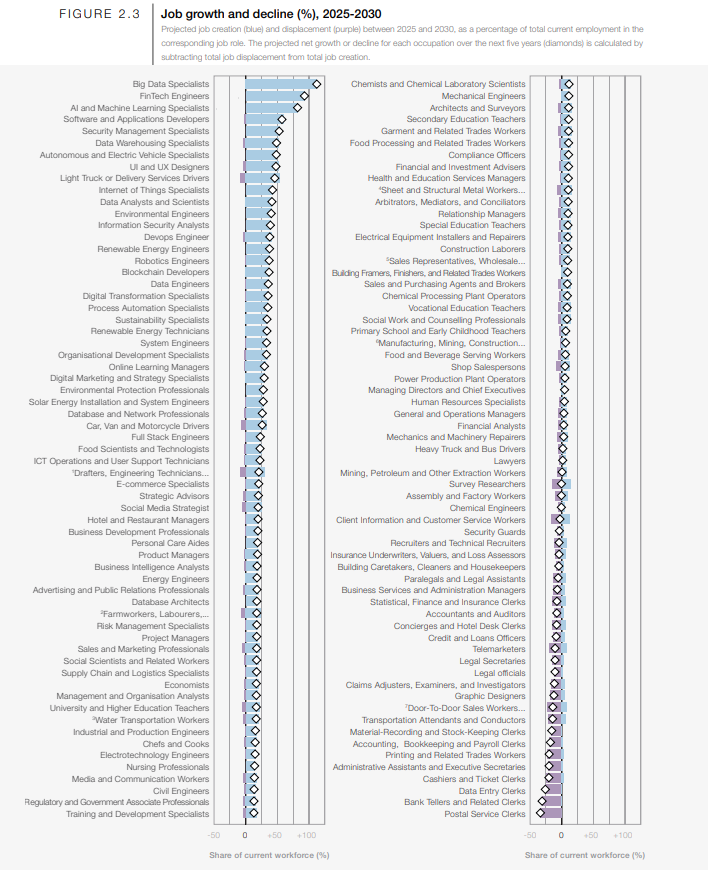
Even so, the evolution of AI will not eliminate humans from the global workforce. Workplaces will continue to be populated by inherently irrational human beings. The importance of Emotional Intelligence will actually increase as a critical competency for collaborating effectively with these human colleagues.
Cultural Intelligence (CQ) for Cross-Border Collaboration
Moreover, countries today are more closely connected than ever. The ability to collaborate with people from different cultures, CQ (Cultural Intelligence), is also indispensable.
CQ is a concept proposed in 2003 by Christopher Earley and Soon Ang. Professor Soon Ang is also a researcher at Nanyang Technological University (NTU), here in Singapore.
Working in ASEAN, I feel the importance of CQ every day. Between Japanese expatriates and national staff, there are differences not only in language, but also in how work gets done and in what each side takes for granted. Building trust across those differences is not something you can delegate to AI.
From IQ to EQ, and then to CQ: I understand this as an era in which not just intelligence, but the ability to build relationships with people, is being asked of us "even more."
Chapter 5:
Keep Understanding, So You Can Take Responsibility
"The chatbot said it on its own" does not hold up
The fourth point is responsibility. In human society, when something happens, someone has to take responsibility. And AI cannot do that. More precisely, human society does not allow AI to do so.
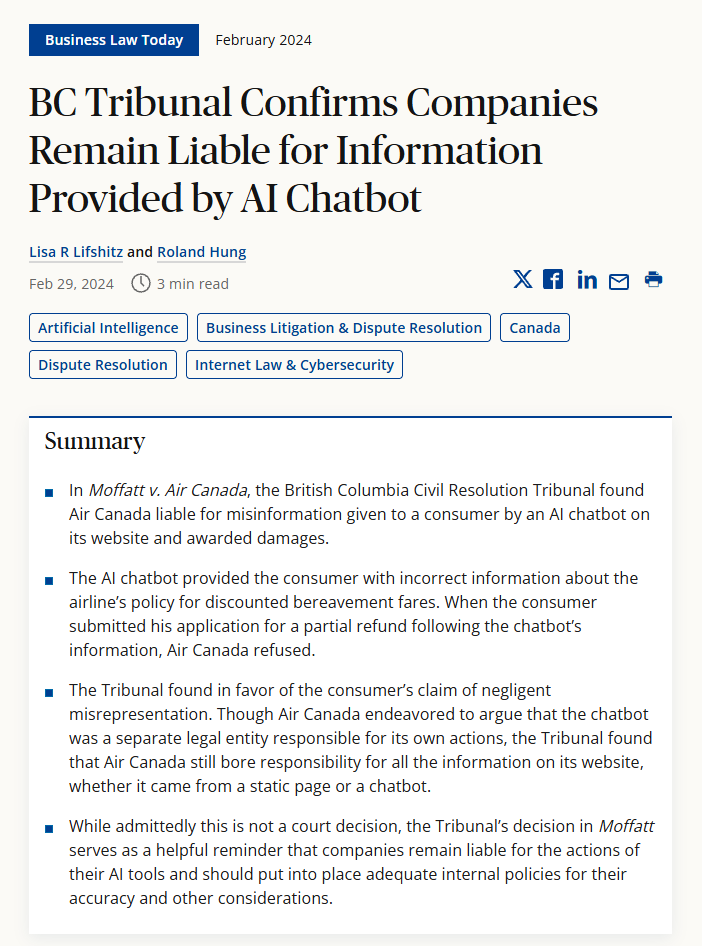
There is a case that symbolizes this. On the website of the Canadian airline Air Canada, an AI chatbot gave a passenger incorrect information about fare rules. When the passenger requested a refund, the company argued, in effect, that "the chatbot is a separate entity, and the company is not responsible for what it says."
In 2024, a Canadian tribunal rejected this argument. It ruled that the chatbot is part of the company's website, and that the company is responsible for the information provided there.
No matter how smart AI becomes, responsibility will remain with people and organizations (unless the underlying laws change). This is not a question of technology, but a question of the conventions our society runs on.
How will the center of gravity of skills shift?
Let me organize the discussion so far from the perspective of skills.
A classic framework for managerial skills is the "Katz model," proposed by Robert Katz in 1955. It consists of three skills: technical skills (the ability to perform tasks), human skills (interpersonal ability), and conceptual skills (the ability to conceptualize). Katz argued that the higher one's position, the more the emphasis shifts from technical to conceptual skills.
What happens in the age of AI, I believe, is that this shift in the center of gravity happens to everyone, regardless of position.
The scope of task execution itself that AI handles expands
Conceptual skills to envision what to aim for (Chapter 2)
Human skills to build relationships of trust with people (Chapters 3 and 4)
And a mindset about what we value: our values, beliefs, and philosophy
The skill mix once required of senior management will come to be required of everyone, including young employees. I think this is the major change in people development in the age of AI.
But technical skills are not "unnecessary"
Here, we must not make one big mistake. Even if the importance of technical skills declines, that does not mean we no longer need to understand the work.
In fact, the data show the opposite. In the WEF report mentioned earlier, the top three skills expected to grow most in importance by 2030 were AI and big data, networks and cybersecurity, and technological literacy.
So, to be precise, we should put it this way:
What becomes less important: the skill of carrying out individual tasks with your own hands?
What becomes more important: the literacy to understand technology, including AI, and to oversee its work?
What happens if you delegate without understanding?
Suppose your job were simply to run AI agents without understanding the work. When a problem arises, you are the one who takes responsibility. But if you do not understand what is happening, there is no way you can take responsibility.
And what is frightening is that if you keep leaving things to AI, that very ability to understand may be lost.
A study published in 2025 in the medical journal The Lancet Gastroenterology & Hepatology illustrates this. At four medical centers in Poland, an AI-assisted tool was introduced for colonoscopy. The subjects were 19 experienced physicians, each with more than 2,000 procedures under their belt.
Three months after they began using AI routinely, their adenoma detection rate when performing the procedure without AI had fallen from 28.4% to 22.4%. As they came to rely on AI, the physicians' own "ability to see" had weakened.
This is a change that can occur in just three months, even among skilled experts. Mastering AI and handing your judgment over to AI are completely different things.
To take responsibility, you have to keep understanding. Technical skills in the age of AI have transformed from "the ability to do it yourself" into "the ability to understand, judge, and take responsibility."
Chapter 6:
Five Questions for Executives and People Development Leaders
So how should you rethink talent development within your own organization? The exact answer naturally differs for every corporate entity. Therefore, to conclude this discussion, I will not offer prescriptive answers. Instead, I will leave you with five strategic questions.
Vision : Is our development only producing people who "do today's job well," as an extension of the past? Are we developing people who can envision a discontinuous future and have the will to bet on it?
Firsthand information : Do our people step away from their screens and go to the front line? And have they built relationships of trust with clients and partners who will bring them firsthand information when it is needed?
Emotional Intelligence : Are we stopping at teaching the "right answers" about emotions as knowledge? Are we making it a development goal to build relationships in which team members and colleagues feel, "I can accept it, because it's coming from this person"?
Cultural Intelligence : Are we developing the ability to bridge the differences in what is "taken for granted" between expatriates and national staff, and between headquarters and local subsidiaries?
Responsibility and understanding : For the work we have handed over to AI, is there someone in the company who can explain what is going on? Is our ability to make judgments without AI quietly eroding?
Conclusion:
The Stronger AI Becomes, the More Human Leadership Becomes
I will return to the question posed at the very beginning. "How will talent development change in the age of artificial intelligence?"
The question we must ask is not about capabilities and limitations. Rather, even as artificial intelligence evolves faster than we can imagine and becomes capable of more, what are the core responsibilities humans must continue to fulfill? It is the strategic will to bet on the future. It is the integrity to verify primary data on the ground. It is the ability to build trusted interpersonal relationships. It is the readiness to maintain accountability for final outcomes.
None of these are new skills. Rather, they are all qualities that have traditionally been demanded of excellent leaders. Now that artificial intelligence is handling a massive portion of our daily workflows, these human qualities are simply being demanded of everyone much more strongly. Perhaps that is all there is to this transformation.
As artificial intelligence becomes stronger, leadership becomes more human. That is what I believe.
References
Si, C., Yang, D., & Hashimoto, T. (2024). Can LLMs Generate Novel Research Ideas? A Large-Scale Human Study with 100+ NLP Researchers (https://arxiv.org/abs/2409.04109). arXiv(ICLR 2025).
Si, C., Hashimoto, T., & Yang, D. (2025). The Ideation-Execution Gap: Execution Outcomes of LLM-Generated versus Human Research Ideas (https://arxiv.org/abs/2506.20803). arXiv.
2026 Bangkok floods (https://en.wikipedia.org/wiki/2026_Bangkok_floods). Wikipedia.
Associated Press (September 28, 2026). Bangkok floodwaters begin to ease after torrential rains affect 700,000 people (https://www.washingtontimes.com/news/2026/sep/28/bangkok-floodwaters-beginning-ease-torrential-rains-affect-700000/).
Binz, M., et al. (2025). A foundation model to predict and capture human cognition (https://www.nature.com/articles/s41586-025-09215-4). Nature, 644.
Schlegel, K., Sommer, N. R., & Mortillaro, M. (2025). Large language models are proficient in solving and creating emotional intelligence tests (https://archive-ouverte.unige.ch/unige:185363). Communications Psychology.
World Economic Forum (2025). The Future of Jobs Report 2025 (https://www.weforum.org/reports/the-future-of-jobs-report-2025/digest).
Earley, P. C., & Ang, S. (2003). Cultural Intelligence: Individual Interactions Across Cultures. Stanford University Press.
Moffatt v. Air Canada, 2024 BCCRT 149 (https://www.americanbar.org/groups/business_law/resources/business-law-today/2024-february/bc-tribunal-confirms-companies-remain-liable-information-provided-ai-chatbot/) (commentary by the American Bar Association).
Katz, R. L. (1955). Skills of an Effective Administrator. Harvard Business Review, 33(1).
Budzyń, K., et al. (2025). Endoscopist deskilling risk after exposure to artificial intelligence in colonoscopy: a multicentre, observational study (https://wrap.warwick.ac.uk/id/eprint/191005). The Lancet Gastroenterology & Hepatology, 10(10), 896–903.