

DESGIN THINKING : INNOVATIVE THINKING

Transform Complex Challenges into Innovation Opportunities
In today’s fast-changing business environment, organisations need more than ideas. They need a practical way to solve problems, understand customer needs, and develop solutions that create real value.
Our Design Thinking Training is built to help leaders, managers, and professionals approach challenges with a human-centred, customer-focused, and innovation-driven mindset. Through a hands-on learning experience, participants will explore proven methods to solve complex business problems, unlock creative thinking, and turn insights into action.
Whether your goal is to improve products, services, customer experience, or internal processes, this program equips your team with the tools to innovate with purpose.
Ready to build a stronger innovation culture?
Join our Innovation in Action Program and learn how to move from problem identification to practical solution design with confidence.
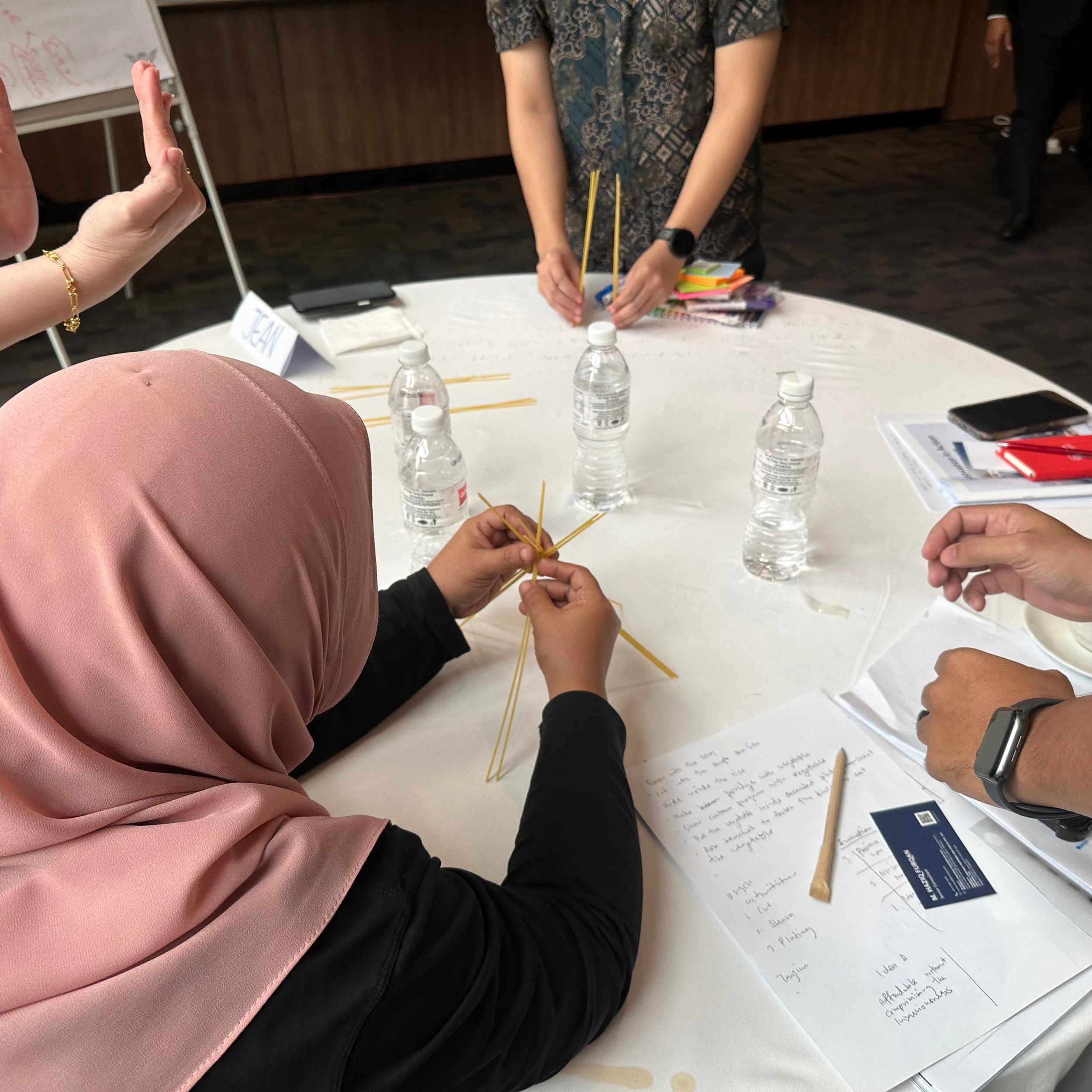
Learning Objective
What You Will Learn
By the end of this Design Thinking workshop, participants will be able to:
Understand how to approach dynamic and complex problems, including today’s “wicked problems,” with greater clarity and structure.
Learn and apply the 5-phase Design Thinking framework through a practical and hands-on approach.
Build a game-changing mindset and behaviour that places customers at the centre of innovation.
Develop stronger capabilities in creative problem solving, idea generation, and solution development.
Apply Design Thinking principles to real business, workplace, and customer challenges.
This section is based on the learning objectives in your attached reference, which emphasize solving complex problems, learning the 5-phase framework, and centralising customers as the fuel for innovation.
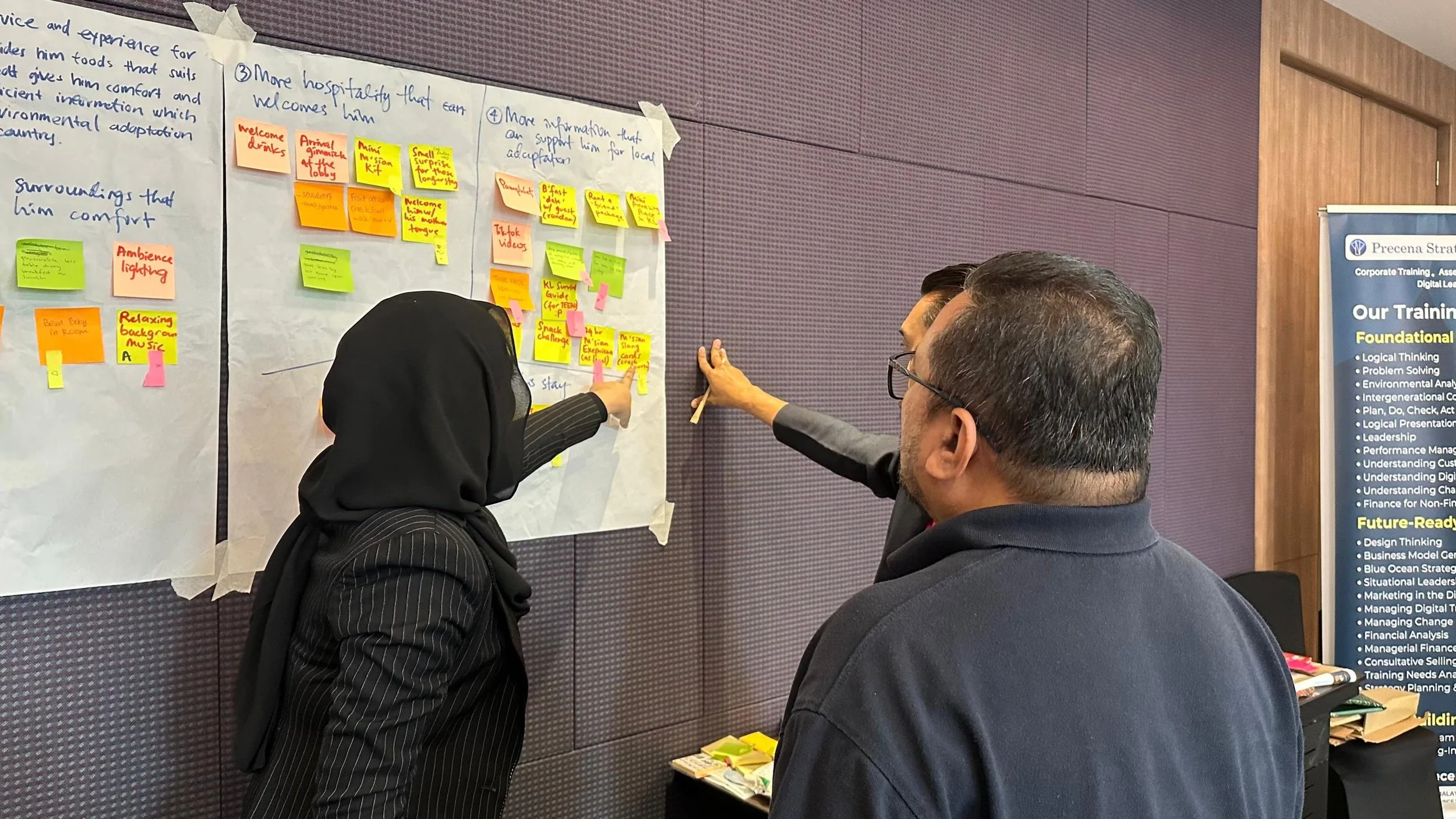
Key Content
This program is designed to make Design Thinking practical, relevant, and immediately applicable in the workplace.
Participants will explore:
Understanding the problems of today’s world
Learn why many business and organisational challenges are no longer simple, and why traditional linear thinking is often insufficient.The mindset of effective design thinkers
Discover how successful innovators think, behave, and reframe problems through a more open, empathetic, and opportunity-focused lens.The 4C mindset of Design Thinkers
Build the behavioural foundation needed to support innovation, collaboration, and customer-centred thinking.The 5-phase Design Thinking model
Gain a structured understanding of each stage and how they work together to support innovation.Deliverables in every phase
Learn what should be produced at each stage, from insight gathering to solution testing.Practical tools and applications
Explore the tools and techniques that help activate each phase in a real business context.Common mistakes and implementation challenges
Identify the typical barriers teams face when applying Design Thinking and how to overcome them effectively.Innovation challenge and idea generation
Put your learning into action by working through a challenge designed to stimulate fresh thinking and new solution development.
This content reflects the topics listed in the attached document, including understanding current problems, the 4C mindset, the 5-phase model, deliverables, tools, mistakes, challenges, and idea generation.
Key Framework
The 5 Phases of Design Thinking
Our program is anchored in the internationally recognised 5-phase Design Thinking framework, giving participants a clear and actionable path from challenge to solution.
1. Empathise
Understand the people you are designing for by exploring their needs, behaviours, pain points, and motivations.
2. Define
Clarify the real problem to solve by turning observations and insights into a focused problem statement.
3. Ideate
Generate a wide range of creative and relevant ideas before selecting the most promising directions.
4. Prototype
Turn ideas into simple, tangible concepts that can be shared, explored, and refined.
5. Test
Gather feedback, validate assumptions, and improve the solution through iteration.
The framework shown in your reference document presents these same five stages: Empathise, Define, Ideate, Prototype, and Test.